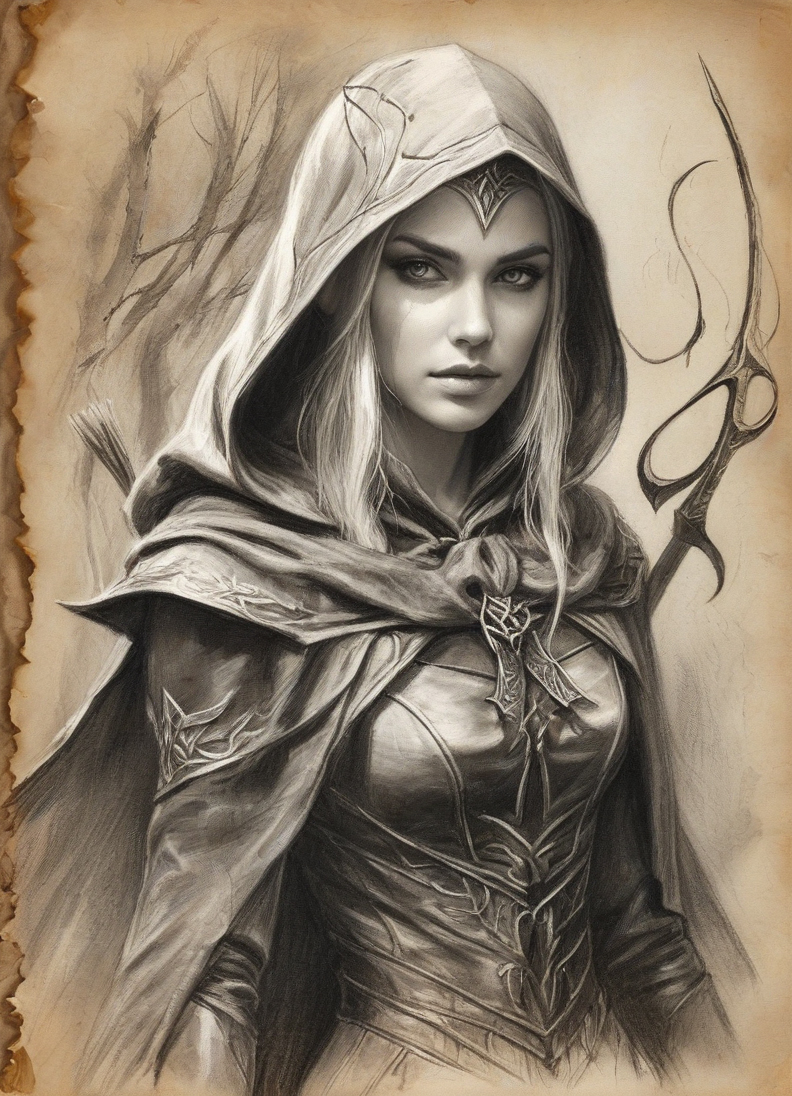
The elf, a cornerstone of modern fantasy, originates from one of the most complex and adaptable figures in Europe’s mythic imagination. Emerging from the ancient belief systems of the Germanic and Norse peoples, elves have undergone a profound transformation[¹]. They evolved from ambiguous, powerful spiritual forces linked to land, ancestry, and illness into the noble, immortal beings central to today’s epic tales[²].
Their journey through folklore, literature, and popular culture reveals not only the evolution of a mythical race but also mirrors humanity’s own shifting relationship with nature, the divine, and storytelling itself.
The Ancient Word and Its Meaning
The very name “elf” holds clues to its original nature. The word is found throughout the Germanic languages—Old English ælf, Old Norse álfr, Old High German alp—all tracing back to the Proto-Germanic root albiz[¹]. Scholars widely connect this root to the concept of “whiteness” or “brightness,” linking it to the Latin albus (white)[³]. This suggests the earliest term may have meant “the white one.” While some, like folklorist Jakob Grimm, saw this as a mark of luminous divinity, modern scholars like Alaric Hall propose it might have been a euphemism or associated with a pale, ethereal beauty[⁴]. This foundational idea of a bright being would later splinter into the vastly different elf figures found across Europe.
Early Germanic Lore: Dangerous Neighbors and Powerful Names
In early Anglo-Saxon England, elves appeared not in grand myths but in practical, often fearful contexts. Old English medical texts and charms consistently portray them as malignant forces causing illness[²]. Ailments like sudden stabbing pains were attributed to “elf-shot” (ælfscoten), believed to be invisible projectiles fired by elves[⁵]. The famous charm Wið færstice (“against a stabbing pain”) describes using herbs and incantations to counteract these elf-induced afflictions[⁵].
This sinister view is echoed in the epic Beowulf, where “elves” (ylfe) are listed alongside giants and demons as the monstrous, god-cursed offspring of Cain[¹]. Yet, this negative portrayal exists in stark contrast to their role in society. The element ælf- was a common and prestigious component in Anglo-Saxon personal names, such as Ælfred (“elf-counsel,” the source of “Alfred”) and Ælfwine (“elf-friend”)[⁴]. This paradox suggests elves were seen as possessing a potent, inherent power—a force that was dangerous if crossed but could also be a source of strength and protection when invoked through namesake.
The Norse Álfar: Ancestral Spirits and Divine Kin

In the Norse world, the concept of the álfar (elves) was more fully integrated into cosmology, occupying a revered and liminal space. They were often seen as protective spirits of the land and lineage, closely associated with fertility and the honored dead[²].
Evidence from Old Norse poetry and sagas shows they were held in high regard. Eddic poetry frequently pairs “Æsir ok Álfar” (the gods and the elves) in ritualistic phrases, suggesting elves were invoked alongside major deities[³]. The link to ancestors is particularly strong. The Þáttr Ólafs Geirstaða Alfs tells of a king who, after death, was worshipped as an elf and believed to be reborn in a descendant[²]. Furthermore, the god Freyr—a deity of kingship, peace, and prosperity—was said to rule Álfheimr (Elf-home), connecting elves directly to concepts of fertility and communal well-being[³].
Historical sagas also reference the álfablót (elf-sacrifice), a private, household ritual. In Kormáks saga, a wounded man is told to make an offering of bull’s blood to the elves dwelling in a local hill to secure his healing[²]. This practice underscores their role as local spirits who could be propitiated for health and favor, blending the concepts of land spirit, ancestor, and minor deity.
The Great Schism: Snorri Sturluson and the Light-Dark Divide
The most famous categorization of elves comes from the 13th-century Icelandic scholar Snorri Sturluson. In his Prose Edda, written to preserve pagan lore for a Christian audience, he introduced a clear, moralistic dualism[³]:
- Ljósálfar (Light Elves): Residing in Álfheimr, they were described as “fairer than the sun to look upon.” Snorri later symbolically places them in a heavenly realm, drawing a clear parallel to Christian angels.
- Dökkálfar (Dark Elves): Dwelling underground, they were “blacker than pitch” in both appearance and nature, mirroring the concept of demons.
This stark division is highly contentious among modern scholars. Many argue it is a late, Christian-influenced construct that Snorri imposed on the more morally ambiguous pagan álfar, possibly conflating “dark elves” with the dwarves (dvergar) of older myths[⁴]. Crucially, the terms ljósálfar and dökkálfar appear almost exclusively in Snorri’s work and are absent from the older, pre-Christian Poetic Edda[⁴]. This leads scholars like Alaric Hall to caution that Snorri’s account of elves is one of his least reliable reconstructions of pagan belief, instead reflecting a medieval Christian effort to categorize all supernatural beings into binaries of good and evil[⁴].
From Folklore to Fairy Tales: The Shrinking Elf
After the medieval period, belief in elves persisted strongly in the folk traditions of Scotland and Scandinavia[¹]. Here, they were thought of as magically powerful people living invisibly alongside humans, still blamed for sickness and misfortune, and feared as seducers in ballads like Thomas the Rhymer[²].
However, in literature, their image began to change dramatically. Influenced by works like Shakespeare’s A Midsummer Night’s Dream, elves were gradually reimagined in the popular consciousness as tiny, playful, and whimsical sprites[¹]. This literary miniaturization was cemented by 19th-century Romanticism. The Brothers Grimm, in collecting Germanic folk tales, often presented elves (Elben) as helpful or tricky nature spirits, further entrenching the image of the small, pointy-eared creature[¹]. A parallel development was the invention of Christmas elves in late-19th-century America—diminutive, industrious toy-makers who represent the complete domestication and sanitization of the older, perilous elf into a figure of commercial folklore[¹].
The Tolkien Revolution: Reclaiming the Archaic Majesty
The most profound reshaping of the elf archetype occurred in the 20th century, engineered by scholar and author J.R.R. Tolkien. A philologist deeply versed in Old English and Norse literature, Tolkien deliberately bypassed the Victorian “flower-fairy” to reconnect with the grandeur and melancholy of the medieval sources[²].
His elves, the Eldar, are a direct synthesis of ancient concepts[²]:
- Tall, Human-like, and Immortal: He restored their stature and majesty, making them equal to or greater than humans.
- Wise and Sorrowful: They possess profound knowledge and artistry but are burdened by the weight of millennia and the fading of magic from the world.
- Structurally Central: In The Lord of the Rings, they are not mere sprites but a noble, ancient race whose history, wars, and choices are inextricably woven into the fate of the world.
Tolkien fused the luminous beauty of the Norse álfar, the noble semantics of Anglo-Saxon elf-names, and the Celtic pathos of a diminishing magical people[²]. In doing so, he created the definitive template for the “high fantasy” elf. This template—graceful, long-lived, magical, and inherently noble—directly inspired the elves of Dungeons & Dragons, The Elder Scrolls, World of Warcraft, and virtually all subsequent fantasy world-building, ensuring the ancient álfar found a powerful new home in the modern imagination[²].
Conclusion: An Enduring Legacy
Today, the legacy of the elves exists in a fascinating tripartite state. They thrive as fantasy archetypes, continually adapted and sometimes subverted in novels, games, and films. They persist as cultural heritage, most notably in Iceland where respect for the huldufólk (“hidden people”) can influence land-use decisions[⁵]. And they endure as a subject of scholarly reconstruction, where academics work to peel back layers of Christian interpretation to better understand the pre-Christian spiritual world[⁴].
From their origins as “white beings” of ambiguous power—simultaneously feared and honored—elves have traveled a remarkable path[¹]. They were systematized by medieval scholars, miniaturized by poets, and sentimentalized by folklorists. Ultimately, their ancient majesty was resurrected by Tolkien, whose work forged a permanent bridge between the scholarly and the popular[²]. The story of the elves is, in essence, the story of how humanity’s ancient sense of wonder, its fear of the unknown, and its longing for lost beauty can be perpetually re-mythologized to inspire every new age.
Sources:
[¹] Wikipedia – Elf: https://en.wikipedia.org/wiki/Elf
[²] Ancient Origins – The Forgotten Story of the Original Elves: https://www.ancient-origins.net/myths-legends-europe/elves-0012315
[³] Britannica – Elf: https://www.britannica.com/art/elf-mythology
[⁴] Alaric Hall, Elves in Anglo-Saxon England (2007) – Cited analysis on Snorri & semantics.
[⁵] University of Glasgow – “Elfshot” and later folklore: Referenced in various folklore studies.