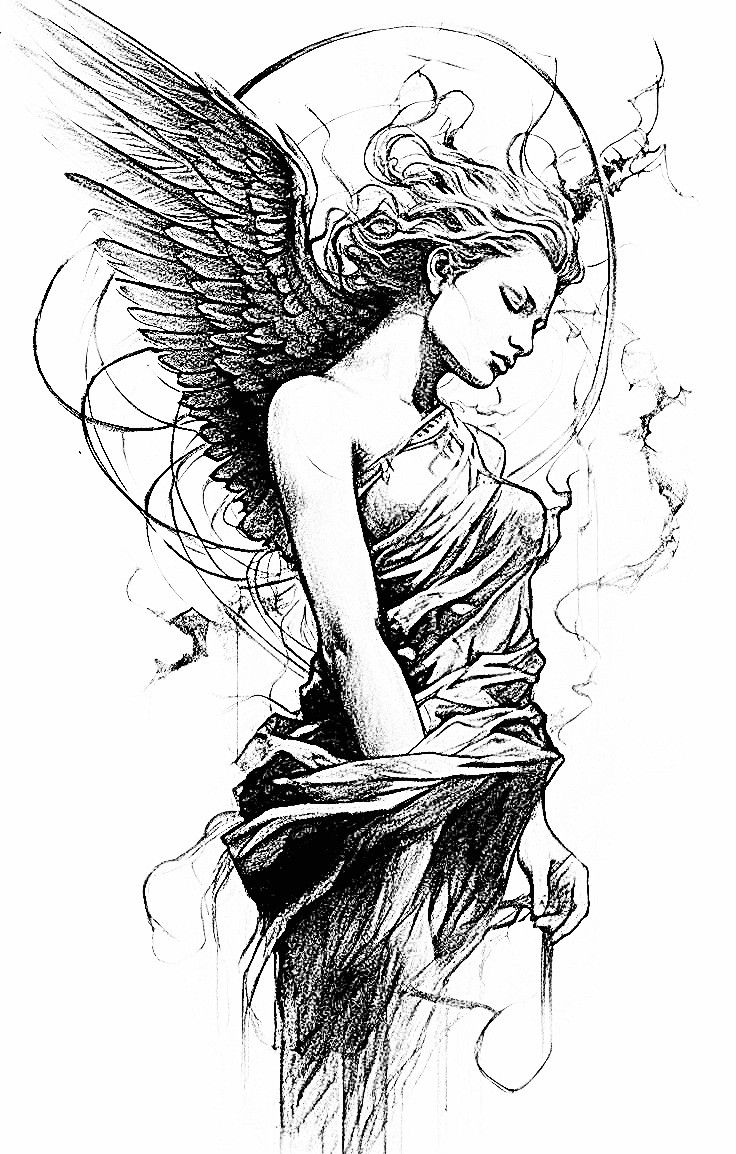
Angels (from the Latin Angelus, meaning “messenger”) are a race of spiritual beings intermediate between God and men; described in Hebrew, Christian, and Islamic scriptures, as well as in the Kabala. They are usually depicted with wings (but not always) and have no gender unless granted physical form in a mission to the Earthly realm. In religions based on revelation, God and humans are distant from each other; Angels help bridge the gap.
Angels praise God, carry out God’s will, and reveal divine word. They may also help people attain salvation or receive special favors. Furthermore, acting for God, angels may influence human affairs through such deeds as rewarding faithful believers, punishing people who do evil, and helping people in need.
Angels tend to play a lesser role in religions with many gods. The gods themselves may carry out angelic functions, often taking human forms. In religions based on the belief that all the cosmos is sacred and that the divine and the human share one essence, angels are less important. They are not needed to bridge a gap between the gods and humankind. However, even in these religions angel-like spiritual beings may help people relate to the divine.
The Nature of Angels
The world’s religions have had different views about the nature of angels. Some regard angels as divine beings who deserve to be worshiped rather than just as messengers of God. Disagreement also exists about the bodies of angels. Some think that angels have actual physical bodies. Others insist that angels only appear to have such bodies. Still others believe that angels are purely spiritual beings but that they can assume material bodies.
The Celestial Hierarchy: The Christian Choirs of Angels
A highly detailed organization of angels emerged in Christian theology, most famously articulated by a mysterious 5th or 6th-century theologian known as Pseudo-Dionysius the Areopagite. His work, De Coelesti Hierarchia (“On the Celestial Hierarchy”), organizes the heavenly host into nine orders, grouped into three descending spheres based on their proximity to God and their specific functions.
The First Sphere consists of angels who serve closest to the throne of God. These are the Seraphim, whose name means “the burning ones” and who perpetually sing praises to God. The Cherubim are associated with the fullness of divine knowledge and wisdom, often depicted as powerful, multi-faced guardians. The Thrones (or Ophanim) symbolize divine justice and the exaltation of God’s authority.
The Second Sphere consists of angels who execute God’s governance over the cosmos. Dominions regulate the duties of lower angels and govern the stars and planets. Virtues are associated with the bestowal of grace and the performance of miracles. Powers are warrior angels who maintain cosmic order, combat evil forces, and protect human souls from demonic influence.
The Third Sphere is the one most directly involved with humanity. Principalities guide and protect nations, institutions, and large groups. Archangels are high-ranking messengers who carry out God’s most important missions to humanity (e.g., Michael, Gabriel, Raphael). Finally, Angels is the order closest to people and includes the guardian angels who serve as personal protectors and messengers. This hierarchical system was adopted and expanded upon by later theologians like Thomas Aquinas and became foundational to medieval Christian angelology.
Zoroastrianism and Judaism: Foundational Influences
The view of angels in Judaism was profoundly influenced by Zoroastrianism, one of the world’s oldest monotheistic religions. Zoroastrian mythology describes a cosmic clash between Ahura Mazda (the Wise Lord) and Angra Mainyu (Ahriman)—forces of good and evil with their armies of angels and devils. Like Ahura Mazda, the Old Testament god Yahweh has an army of angels. These warrior angels battle against evil forces led by Satan, who resembles Ahriman.
The Zoroastrian angelic system is sophisticated and features distinct classes. The highest are the Amesha Spentas (Archangels or “Beneficent Immortals”), who personify abstract virtues and preside over aspects of creation, such as Vohu Manah (Good Purpose) and Asha Vahishta (Highest Truth). The Yazatas (“Adorable Ones”) are a vast number of spiritual beings worthy of praise who protect humanity and personify elements of nature, including figures like Mithra and Anahita. One of the most influential concepts is the Fravashi, a divine guardian spirit that guides each individual’s soul through life and after death. They are said to “fly like winged birds,” and the famous Zoroastrian symbol of the faravahar is traditionally interpreted as a depiction of a Fravashi.
Following the Zoroastrian cosmological view, Judaism came to divide the universe into three parts: earth, heaven, and hell. Earth is the home of humans. Heaven is reserved for God and his angels. Hell is the dark world of Satan and his followers. Angels fulfill a similar role in the two religions, linking heaven with the world of humans and revealing God’s plans and laws. Their function is to serve God and carry out his will. They reward goodness and punish wickedness and injustice. They also help people understand God’s will, and they take the souls of righteous individuals to heaven.
Jewish angelology itself developed various hierarchies. Medieval scholar Maimonides, for example, outlined ten ranks of angels in his work Mishneh Torah, as did other texts like the Zohar. These ranks include the Chayot Ha Kodesh, the Ophanim (wheels), the Erelim, and others, based on descriptions from prophetic visions in books like Ezekiel and Isaiah.
Christianity: Development and Doctrine

The Christian concept of a three-part universe came from Judaic and Zoroastrian ideas, as did Christian ideas of angels and their functions. In the Christian view, angels are God’s messengers. Angels proclaimed the birth of Christ and continue to play an active role in the daily lives of Christians. They bring strength to those who are weak and comfort to those who suffer and carry the prayers of faithful Christians to God. According to legends, guardian angels watch over children.
The New Testament, while affirming the existence of angels, places them firmly in a subordinate position to Christ. However, angelology flourished in the early church. Beyond the Pseudo-Dionysian hierarchy, other Christian traditions developed unique views. The New Church (Swedenborgianism), for example, teaches that all angels were once humans who lived on Earth, and that angelic functions correspond to the useful services they performed in their earthly lives. In the Latter Day Saint movement, angels are typically considered to be either the spirits of deceased humans who have not yet been born, or resurrected beings with physical bodies; notable figures like Adam are identified as the archangel Michael.
Islam: Creation from Light and the Distinction from Jinn
The Islamic idea of angels is similar to Judaic and Christian views. God is in heaven, and the angels serve him and carry out his will. Belief in angels (malāʾika) is one of the six core articles of faith in Islam. They are described as being created from light (nūr), sinless, and without free will, existing solely to obey Allah’s commands. They record human deeds, bring revelation (with Gabriel/Jibril delivering the Qur’an to Prophet Muhammad), and pray for the faithful.
While Judaism and Christianity generally divide spiritual beings into those who are with or against God, Islam presents a more complex cosmology. Alongside angels, Islamic tradition holds that Allah created another species called the Jinn. Created from “smokeless fire,” the Jinn possess free will like humans and can be either believers or unbelievers. A pivotal theological distinction is that Iblis (Satan) is considered a Jinn, not a fallen angel. This is based on Quranic verses stating that Iblis was created from fire and that he disobeyed God’s command to bow before Adam—an act of willful disobedience impossible for angels, who are incapable of disobeying God. This creates a tripartite unseen world of obedient angels, morally ambiguous Jinn, and outright demonic forces.
Islamic scholarship does not have a standardized hierarchy like Christianity, but acknowledges ranks and roles. The archangels Jibril (Gabriel), Mika’il (Michael), Israfil, and Azrael are among the highest. Some scholars, like Fakhr al-Din al-Razi, have proposed groupings that include the angels who carry the Throne of God (Hamalat al-‘Arsh), the recording angels, and the angels of hell.
Representation of Angels: The Origin of Wings
At first, artists struggled with the problem of how to represent angels. Written descriptions were not very helpful. They tended to be vague or bizarre or did not draw a clear distinction between angels and human beings.
Artists tried various approaches before arriving at the image of a young male figure. Later they added two feathery wings to the figure. The wings suggested that angels were spiritual beings elevated above humans and associated with heaven. Besides wings, angels were sometimes shown with halos, long hair, and flowing white robes.
Theologically, angels are understood as purely spiritual beings without physical bodies, though they may assume a visible form when on a divine mission. The now-iconic depiction of angels with wings is an artistic convention, not a doctrinal description. Artists drew upon earlier traditions: the symbolism of birds as messengers, and the iconography of classical gods like Hermes (Mercury), the swift messenger of the gods who was depicted with winged sandals or a helmet. Wings became a powerful visual metaphor for the angel’s role as a divine messenger and their nature as beings that traverse the boundary between heaven and earth.
The visual interpretation of specific angelic orders also evolved dramatically. Biblical Cherubim, described by Ezekiel as awe-inspiring hybrid creatures with four faces and four wings, were gradually softened in Western Christian art. Over centuries, they were conflated with the Greco-Roman putto (a winged baby representing Cupid/Eros), becoming the plump, infantile cherubs familiar today. Seraphim, described by Isaiah as six-winged fiery beings, were traditionally painted red to symbolize their burning love for God.
Contemporary Perspectives and Enduring Fascination
In the modern era, the traditional theological understanding of angels has faced challenges from scientific rationalism and historical-critical biblical studies. Paradoxically, this has been accompanied by a widespread cultural fascination, or “angelmania,” where angels feature prominently in popular media, art, music, and personal spirituality, often divorced from their traditional religious contexts. This contemporary interest is frequently seen as a pendulum swing away from materialism and a search for mystical meaning and comfort.
Despite these modern shifts, within scholarly theological study, angels remain a serious subject. They are explored not merely as relics of ancient mythology but as integral figures that underscore the vastness of God’s creation, the reality of the spiritual realm, and the multifaceted ways the divine interacts with the cosmos. Their enduring presence across millennia of human thought speaks to a persistent intuition—that we are not alone, and that the space between heaven and earth is inhabited.
Sources:
Information for this article was synthesized from a variety of publicly available scholarly and educational resources, including entries from the Encyclopaedia Britannica and Wikipedia on topics such as angelic hierarchies, Zoroastrian angelology, and Islamic theology, as well as resources from academic and religious educational sites like Avesta.org, Portsmouth Cathedral, and Dallas Baptist University.